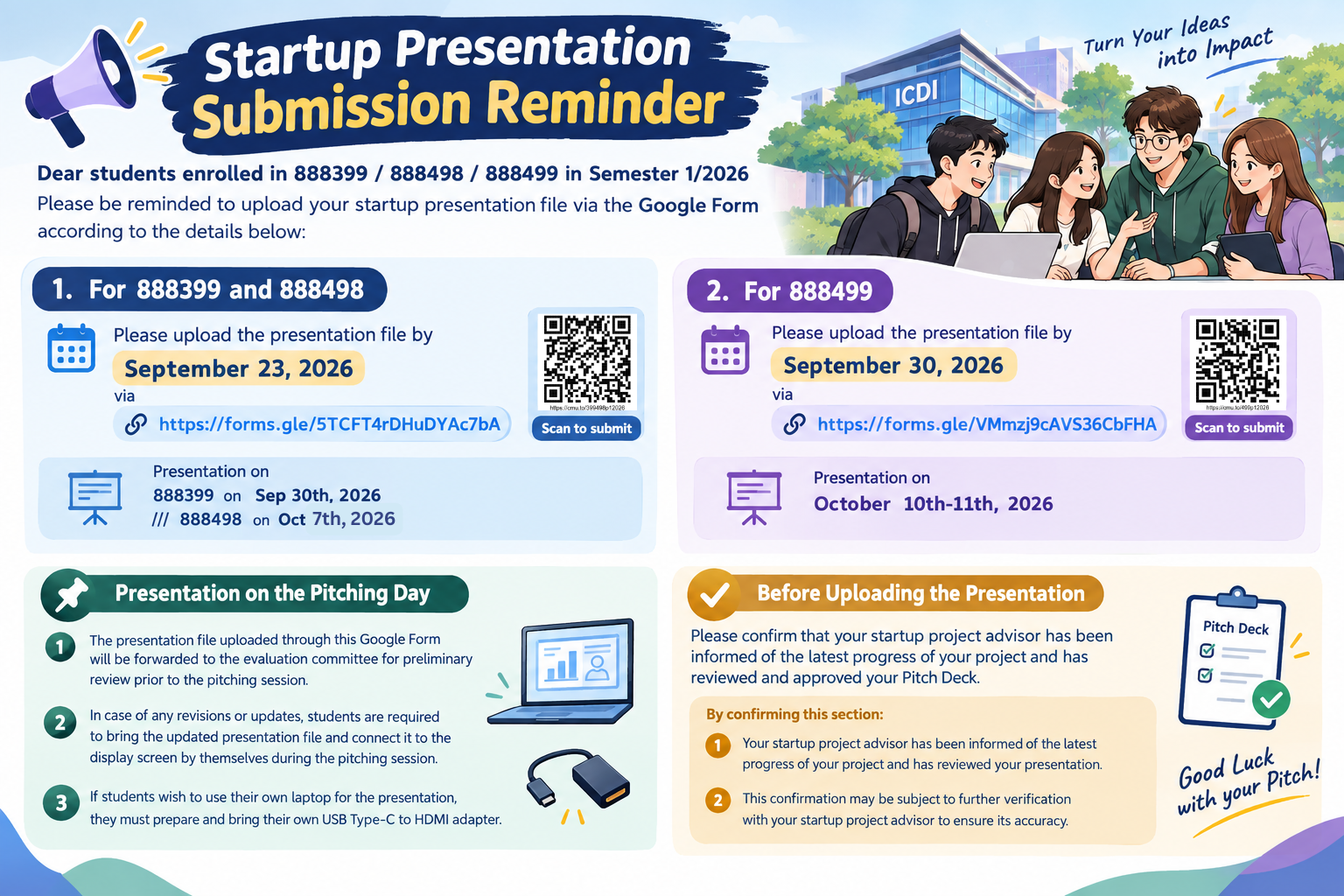
gantt
    title Course Project Timeline - Academic Year 2026/1
    dateFormat  YYYY-MM-DD
    axisFormat  %d %b

    section Semester Start
    Semester Opens (Week 1) :milestone, active, 2026-06-22, 0d

    section Week 4
    Coordinators Briefing Session :active, 2026-07-15, 2026-07-15
    Submit Project Details & Advisor Form :crit, 2026-07-01, 2026-07-22

    section Week 15
    Final Draft & Slides to Advisor :crit, 2026-09-25, 2026-10-01

    section Week 17
    Presentation Approval & Submission :active, 2026-10-01, 2026-10-07

    section Week 18
     Pitching Day (2026-10-10/11):active, 2026-10-10, 2026-10-11

    section Week 19-20
    Submit Final Report & Certificates :crit, 2026-10-19, 2026-11-01

    section Week 19-20
    Defense Project :crit, 2026-10-19, 2026-11-01
888499: Technology Startup Project
TipCourse Conditions
Prerequisite course:
888399: Technology Startup Project Survey
888498: Technology Startup Pre-Project
Register 888498 and 888499 at the same time, but if you fail 888489, you will fail 888499, too.
ImportantTimeline for submitting the financial support documents:
Students must submit the financial support documents from
October 15 to November 6, 2026, 2026(all signatures on the documents must be completed before submission).The final deadline to submit financial support documents is
November 6, 2026.
NO LATE SUBMISSIONS WILL BE ACCEPTED FOR ANY REASON!
Timeline
| Section / Period | Task | Start Date | End Date |
|---|---|---|---|
| Semester Start | Semester Opens (Week 1) | 2026-06-22 | 2026-06-22 |
| Week 4 | Coordinators Briefing Session | 2026-07-15 | 2026-07-15 |
| Week 5 | Submit Project Details & Advisor Form | 2026-07-15 | 2026-07-22 |
| Week 15 | Final Draft & Slides to Advisor | 2026-09-25 | 2026-10-01 |
| Week 17 |  Presentation Approval & Submission |
2026-10-01 | 2026-10-07 |
| Week 18 | Pitching Day (2026-10-10/2026-10/11) | 2026-10-10 | 2026-10-11 |
| Week 19-20 | Submit Final Report & Certificates | 2026-10-19 | 2026-11-01 |
| Week 19-20 | Defense Project | 2026-10-19 | 2026-11-01 |
Who enrolled in this course?
To be update
Main Works
Report: Students need to complete their project report according to the new report format.
- Your report is evaluated by a project examination committee.
Project Defense:
- Your project advisor agree to let you defense your project and find another two committees by your advisor.
- Set up date and time for defense your project.
- You need to submit your project report to the committee at least 1 week before the project defense.
- Present your project to the committee.
ImportantRemarks
There are 2 chances for students to do presentation or pitching:
Round 1: Project advisor cannot join.
Round 2: Project advisor can join.
Communication Form for advisor to check student weekly project attendance. Students need to meet their project advisor at least two weeks once. Otherwise, project advisors have right to not allow students to join project presentations/pitching.
Objectives
Business test run (with at least 2 evidences from below)
MVP with targeted customer feedback
Revenue
Customer engagement, marketing, or online publication
Crowdfunding
Fundraising event participation
Patent filing
Mathematical Simulation to prove the financial sustainability of the project
Academic article publication
Report Topics
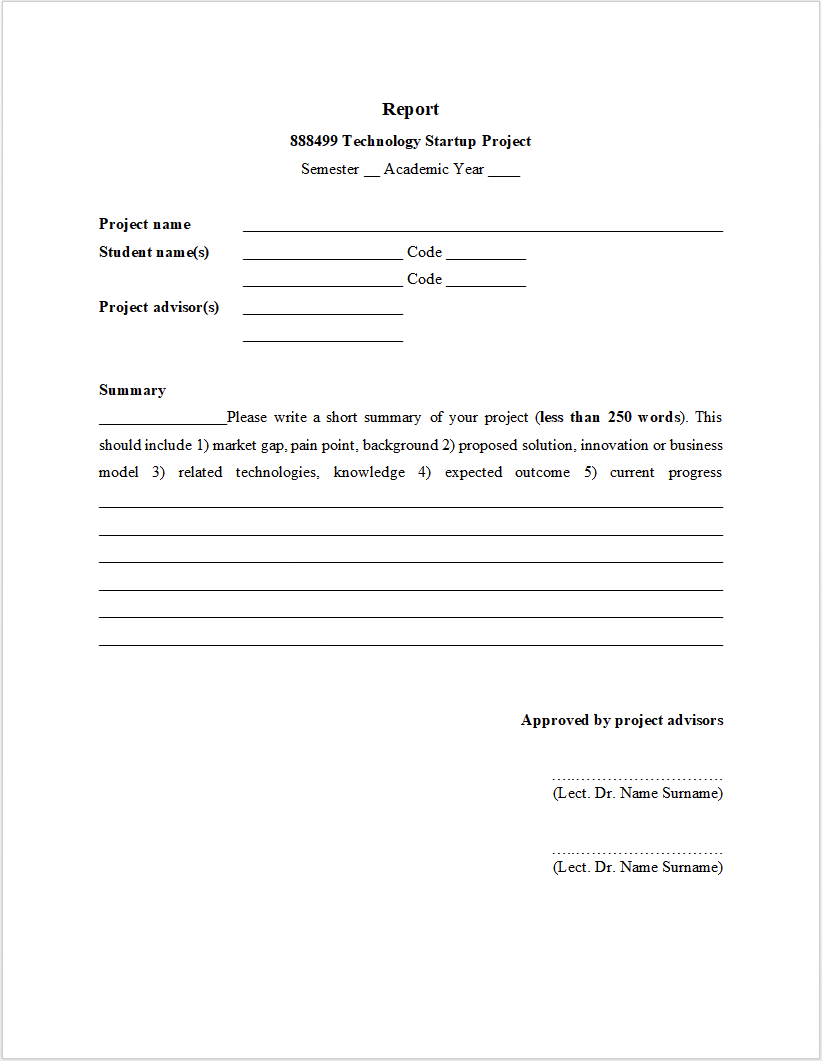
You report contains seven chapters.
Chapter 1: Business Pain Point
Basic information of the industry
Introduction to the pain point/market gap/problem
List of Suggested Solutions
Chapter 2: Limitation, Scope, and Business Model Canvas
Target Customers
Customers journal Analysis (from similar business who solve the same pain point)
Related laws and regulations
Business Model Canvas(BMC)(updated version)
Proof of Concept (POC) for business idea
Survey questions or other methods for the PoC, results of the PoC, and interpretation of the results that verify your pain point
Selected Solution and the reason why you selected this one.
Feasibility (Application of digital/scientific technologies)
Desire (Market needs, Impact to target customers)
Viability (How to make profit?)
Sustainability (What is your competitive advantage?)
Business Plan (updated version)
Business survey and competitor analysis
Risk Analysis (updated version)
Supply chain (supplier, farmer, producer, maker, distributer, retailer, retail channel, etc.) and value chain analysis
Marketing strategies (how you do the marketing for your startup such as application of marketing tools, digital marketing, online and offline marketing)
Financial plan (Capital expenditure, Forecast Income statement, Forecast Breakeven analysis)
Prototypes
Prototype of product/process/service/business model or Minimum Viable Product (MVP)
- Process of creating prototype

- Demonstration
Customer feedbacks
Result of the startup test run (choosing at least two topics and explaining)
MVP and customer feedback
Revenue
Engagement or Marketing product or Online Publish
Crowdfunding
Pitching event (Fundraising event participation)
Mathematical simulation to prove financial sustainability (e.g., product in the insurance industry)
Patent of an innovation
Academic article publication regarding product, service, process, or business model.
You may also choose other topics which show the maturity of your project. The project examination committee will consider it on a case-by-case basis.
- Future Plan
Report template and more details of each chapter: click here
Project Defense Criteria
| Criteria | Score |
|---|---|
| Using digital tools | Pass/Fail |
| Strategy Plan | Pass/Fail |
| Business Test Run (at least 2 out of 8 ) | Pass/Fail |
| Post test run feedback | Pass/Fail |
| Future Plan | Pass/Fail |
ImportantTo pass
Depends on decision of Project Defense’s committees
Pitching Criteria
| Criteria | Score |
|---|---|
| Problem and solution | \(0-5\) |
| Market Opportunity | \(0-5\) |
| Value Proposition | \(0-5\) |
| Business Model | \(0-5\) |
| Competitive Advantage | \(0-5\) |
| Presentation and Communication | \(0-5\) |
You have 5 Mins for Pitching + 10 Mins for Q&A.
ImportantTo pass
Get at least 15 out of 30 to pass.
Problem and Solution: Assess how well the startup identifies and addresses a significant problem or pain point in the market. Evaluate the effectiveness of the proposed solution.
Market Opportunity: Evaluate the size and growth potential of the target market. Consider the startup’s understanding of the market competition, and potential barriers to entry.
Value Proposition: Assess the value that the startup’s product or service brings to customers. Evaluate how compelling the value proposition is and whether it addresses the needs and desires of the target market.
Business Model: Evaluate the startup’s business model, including its revenue streams, pricing strategy, and scalability. Consider the sustainability and profitability of the business model over the long term.
Competitive Advantage: Assess the startup’s competitive advantage or unique selling proposition. Look for factors that differentiate the startup from competitors, such as intellectual property, technology, partnerships, or a strong brand.
Presentation and Communication: Evaluate the clarity, effectiveness, and persuasiveness of the pitch itself. Consider the quality of the presentation, the ability to articulate the key points, and the ability to engage and communicate with the audience.